Resources
Guides and planning tools for referrers
Forensic Disability Supports Queensland publishes eleven guides, each written for one role and each with a free planning tool. They are plain, printable and free to share, and nothing you type leaves your browser.
Guides by role
Eleven guides, one for each role
Each guide covers how your work runs, where placements go wrong and what to ask any provider. The tool at the end of each one produces a document you would otherwise have to write yourself.
-
Support coordinators
A referral pack builder, for the participant other providers have already declined.
-
Lawyers and court teams
A bail support plan builder, for when bail turns on where your client will live and who will support them.
-
Corrections and reintegration
A release readiness planner that works back from the release date, so the first day is planned.
-
NDIA justice liaison officers
A custody to community plan check, for the gap between a plan the National Disability Insurance Agency (NDIA) has approved and a provider on release day.
-
Forensic mental health teams
A step-down planner for each stage of limited community treatment, with the early warning signs.
-
Forensic Disability Service teams
A transition planner for people on forensic orders (disability) moving from the Forensic Disability Service to a home.
-
Behaviour support practitioners
An implementation readiness check for behaviour support plans: authorisation, order conditions, data and training.
-
Youth justice and child safety
A youth order support planner, for young people with disability aged 10 to 17.
-
Guardians and advocates
A provider due diligence checklist: the questions that show whether a provider can hold a forensic placement.
-
Report writers
A report to support mapper, for recommendations a court can order and the NDIA will fund.
-
Plan managers
A plan burn check, to see an overspend or an unusual invoice before the plan runs out.
Family, or referring yourself? Start with the page for families and the person, written in plain language.
Background
Who funds what in the justice system
For a person in custody, on bail, on parole or probation, or on a forensic order. Plain language, with official sources.
Printable documents
Documents to print, forward or take to a case conference
Free PDFs, each with its full text on this site.
All downloads-
Referrer pack
Who we support, the seven programs, where our homes are, how a referral works, and our registration and safeguards.
-
What to send with a referral
A one-page checklist: the four things every referral needs, the one more thing for each program, and how to send it.
-
Bail support plan template
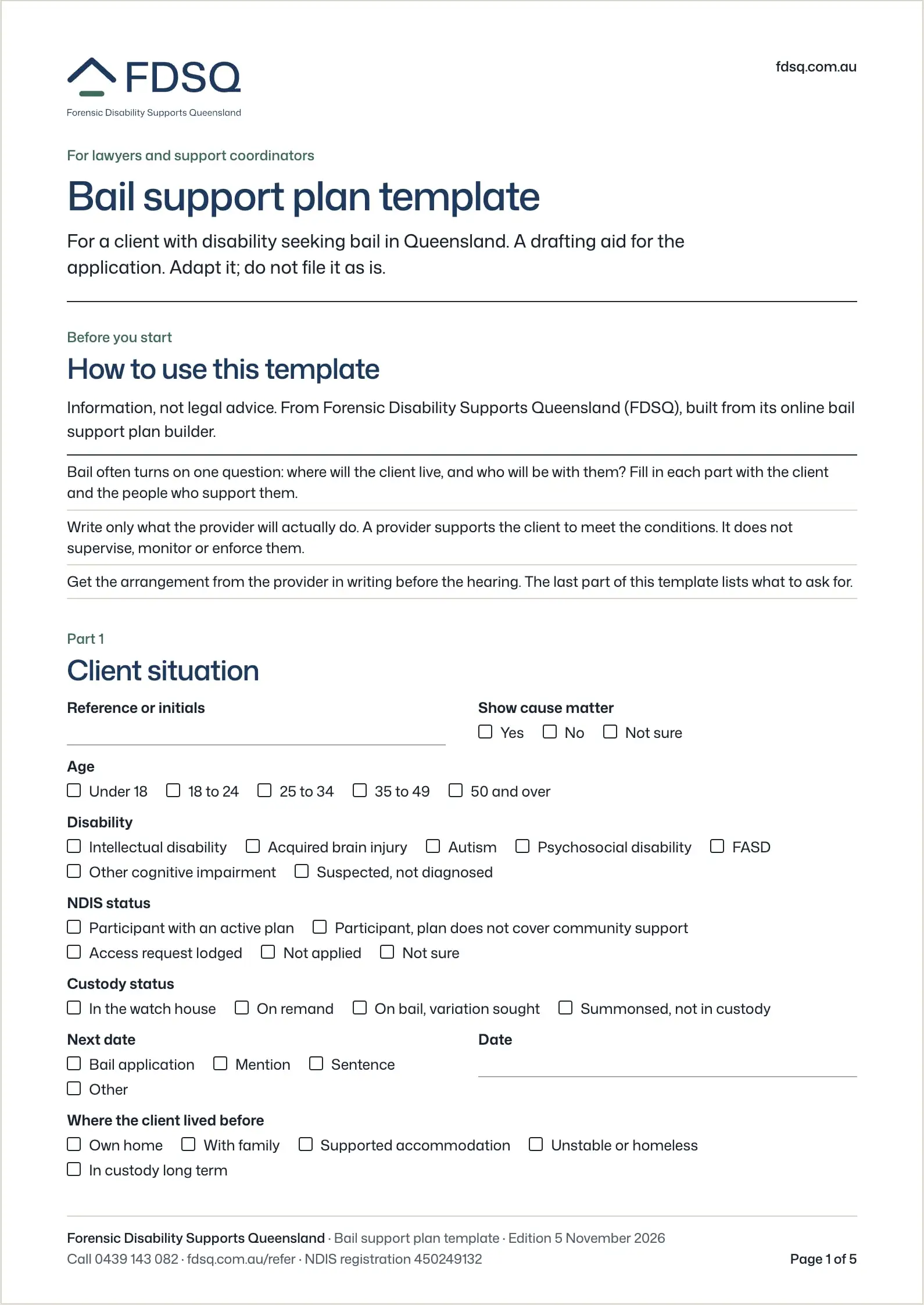
A blank template to fill in on paper for a client with disability seeking bail in Queensland, with a guide to each part.
How the tools work
Every tool works the same way, whichever guide it sits in
Runs in your browser
We do not see, store or receive what you enter. Use initials or your own reference, never names or identifying numbers.
Answer what you can
Every question is optional unless it is marked required. The summary builds as you go, so a half-finished form is still useful.
Copy, print or save as PDF
One summary you can paste into an email, attach to a referral or take to a case conference.
A referral when you want one
Each tool links to the referral form. You get a yes or a no within two hours, seven days a week.
After you refer
What happens when you send a referral
You do not need plan documents in front of you to start. Send what you have, and this is what comes back.
Make a referral-
Within 2 hours
A yes or a no
With a list of what we still need from you.
-
Within 1 day
A first call
Where the person is in custody or a forensic setting, we organise the first in-reach visit.
-
Within 4 days
A matched team
Workers are matched and the roster is built around the person's obligations.
Is what I type stored or sent anywhere?
No. Every tool runs in your browser. We do not see, store or receive what you enter, and nothing is sent when you copy or print. Even so, use initials or your own reference rather than names or identifying numbers.
Do I need to sign up or download anything?
No. Every guide and tool is free, with no sign-up and no email gate. Copy the summary, or print it and save it as a PDF from your browser.
Can I send the summary to other providers?
Yes. The summaries are written for any provider to answer, including FDSQ.
Is the output legal or clinical advice?
No. Each tool is a planning aid. Funding decisions stay with the NDIA, and clinical judgement stays with the treating team or the report writer.
What if none of the guides fits my situation?
Call us on 0439 143 082 and describe it. We will answer the question directly, whether or not the person ends up with us.