For lawyers and support coordinators
Bail support plan template
For a client with disability seeking bail in Queensland. A drafting aid for the application. Adapt it; do not file it as is.
Before you start
How to use this template
Information, not legal advice. From Forensic Disability Supports Queensland (FDSQ), built from its online bail support plan builder.
- Bail often turns on one question: where will the client live, and who will be with them? Fill in each part with the client and the people who support them.
- Write only what the provider will actually do. A provider supports the client to meet the conditions. It does not supervise, monitor or enforce them.
- Get the arrangement from the provider in writing before the hearing. The last part of this template lists what to ask for.
Part 1
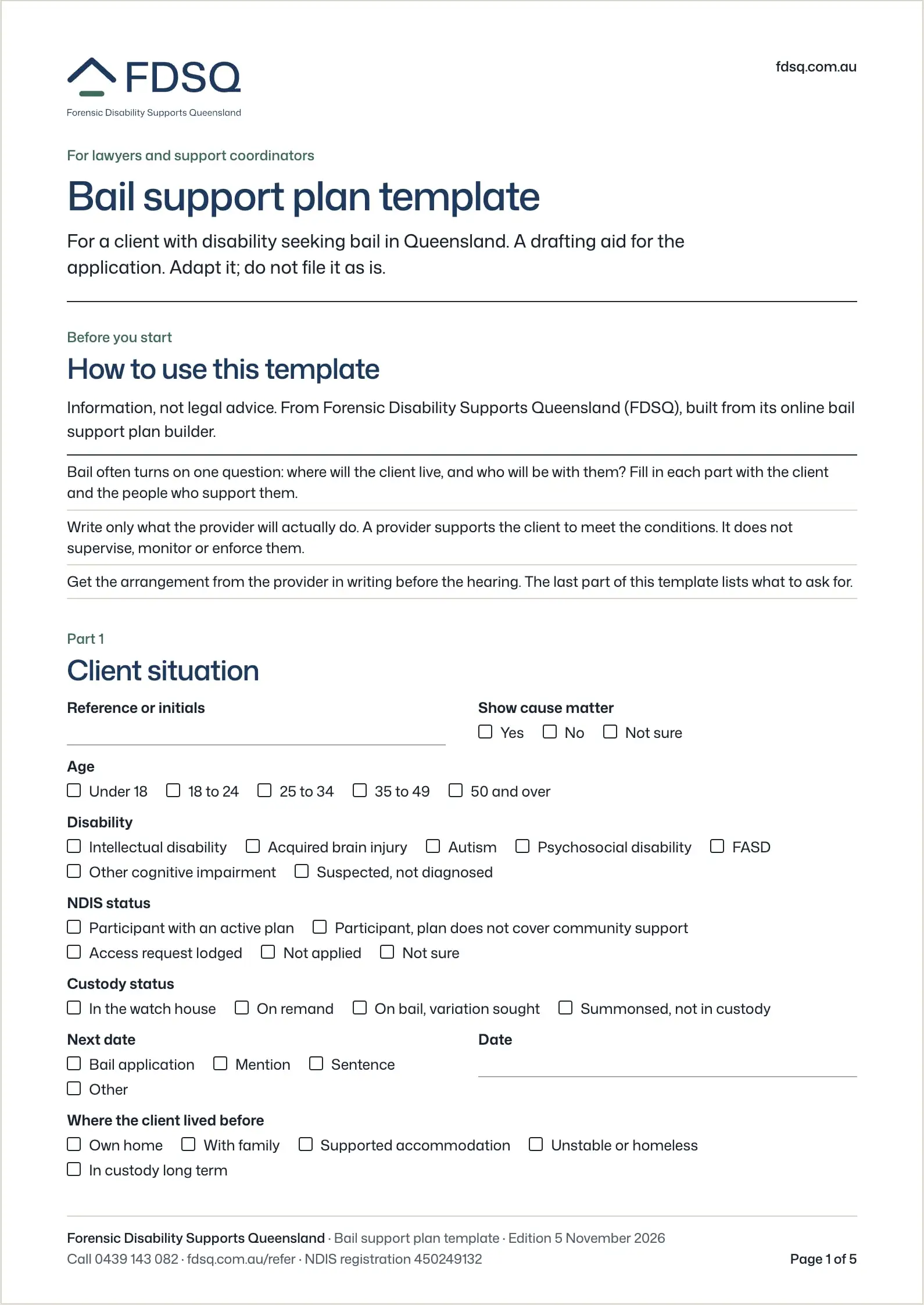
Client situation
-
Reference or initials
-
Show cause matter
Choices: Yes; No; Not sure.
-
Age
Choices: Under 18; 18 to 24; 25 to 34; 35 to 49; 50 and over.
-
Disability
Choices: Intellectual disability; Acquired brain injury; Autism; Psychosocial disability; FASD; Other cognitive impairment; Suspected, not diagnosed.
-
NDIS status
Choices: Participant with an active plan; Participant, plan does not cover community support; Access request lodged; Not applied; Not sure.
-
Custody status
Choices: In the watch house; On remand; On bail, variation sought; Summonsed, not in custody.
-
Next date
Choices: Bail application; Mention; Sentence; Other.
-
Date
-
Where the client lived before
Choices: Own home; With family; Supported accommodation; Unstable or homeless; In custody long term.
Part 1, continued
If NDIS funding or age is an issue
-
NDIS: not applied, or not sure
Without an NDIS plan, an NDIS provider cannot start. Say so to the court plainly. For an adjournment, the access request with functional evidence is the first step; the NDIA has justice liaison officers for exactly this.
-
NDIS: access request lodged
Ask the NDIA justice liaison officer about timing. A provider can confirm what it would deliver once funded.
-
NDIS: plan does not cover community support
The plan will need a change before community support can start. A provider can still confirm the arrangement subject to funding.
-
Age: under 18
For a young person, FDSQ provides in-home support and community access only, and never places a young person with adults.
Part 2
Proposed arrangement
-
Accommodation
Choices: The client's own home; The family home, with the family's written agreement; Supported accommodation arranged by an NDIS provider; Sole occupancy.
-
Stage of the accommodation
Confirmed, identified and proposed are three different things. The bench will ask which. Choices: Confirmed; Identified; Proposed.
-
Address
To be confirmed in writing before the hearing.
-
Support ratio
A disability support worker at 1:1, or 2:1 where set out in a behaviour support plan. Choices: 1:1; 2:1.
-
Also at the residence
Choices: Evening and overnight support; Transport for reporting.
-
Weekly hours, and what funds them
-
Who will be with the client on the first night
The answer should be a name and a shift.
-
Start date and time, including who meets the client on release
-
Supports already involved
Tick each, and write their names and contact details. Choices: Support coordinator; Treating team; Behaviour support practitioner; Guardian; Family.
-
Offence history relevant to housing
Choices: Sexual offence; Arson or fire setting; Neither.
FDSQ supports people with a sexual offence or arson history in sole-occupancy placements only. Offence type alone is not a reason FDSQ declines.
Part 3
How each condition will be supported
Tick the proposed conditions, then write how each will be supported. Adapt the examples.
| Condition | How it will be supported |
|---|---|
| Reside at a set address | For example: The client will be supported to live at the residence by a worker the client knows, in a home set up for the client, with planned activities so that time at home is not time alone. |
| Curfew | Curfew hours. For example, 8pm to 6am. For example: The client will be supported to be at the residence during the curfew hours through an evening routine and support worker presence at the residence. |
| Report to police | Reporting frequency. Daily; Three times a week; Twice a week; Weekly. For example: The client will be supported to report to police by a disability support worker, who will provide reminders and transport. |
| Electronic monitoring | For example: The client will be supported with a daily charging routine and to understand the device. Support workers do not monitor the device. |
| No contact | For example: The client will be supported to keep to the no contact condition, including help to block contacts on devices where the client agrees. |
| Exclusion zone | For example: The client will be given a plain language map of the exclusion zone, and community access will be planned on routes that avoid it. |
| No alcohol or drugs | For example: The client will have a structured day with a worker the client knows, and support to attend alcohol and other drug services. |
| Attend a program or treatment | For example: The client will be supported to attend the program or treatment with reminders and transport, and a worker will attend where the program allows. |
Part 4
Addressing the court's likely concerns
Tick what the court is likely to focus on, then write how the arrangement answers each.
| Concern | How the arrangement answers it |
|---|---|
| Failing to appear | For example: Court dates will be entered in the client's diary and supported by reminders, and a worker will provide transport to court. |
| Offending on bail | For example: The client will have a structured weekly routine with a support worker the client knows, reducing unstructured time. |
| Safety of a complainant | For example: The residence and daily routes will be chosen to keep away from the complainant and any exclusion zone. |
| Interfering with witnesses | For example: Support to maintain no contact conditions, including help to block contacts on devices where the client agrees. |
Show cause matter: the application will need to show why detention is not justified. The support arrangement is part of that case, not the whole of it.
Part 5
Capacity to comply
For example: the conditions will be explained to the client in plain language by support workers, and a visual copy kept at the residence.
Consider whether s 11A of the Bail Act applies.
-
Notes on capacity to comply
Part 6
What the provider is not
The provider supports the client to meet the conditions. It does not supervise, monitor or enforce them, and it does not act for the court or police.
Part 7
Get these from the provider in writing
- The accommodation arrangement and its exact stage: confirmed, identified or proposed
- Start date and time, including who meets the client on release
- Support ratio and weekly hours, and what funds them
- How each condition above will be supported
- How incidents and missed conditions will be communicated, and to whom
- A 24 hour contact number
- What the provider will not do
About FDSQ
A written support proposal you can hand up
For a client with intellectual disability, brain injury, autism or psychosocial disability, FDSQ confirms in writing where they will live and who will support them, and writes only what it will do. A yes or a no within two hours, seven days a week. Court attendance at no charge. Call 0439 143 082, or refer at fdsq.com.au/refer.
Sources
Sources and limits
Bail Act 1980 (Qld), sections 11, 11A and 16.
Information, not legal advice. Bail conditions are set by a court, or by police for watch-house bail.